What are SMART goals and why are they important for marketing teams?
SMART goals are Specific, Measurable, Achievable, Relevant, and Time-bound objectives that help marketing teams create clear, actionable, and trackable targets. According to a Coschedule survey, marketers who set well-defined goals are 376% more likely to report success. SMART goals ensure everyone understands what needs to be achieved and how to measure progress, leading to better alignment and results. [Source]
How do you write effective marketing objectives using the SMART framework?
To write effective marketing objectives, ensure each goal is specific (clearly defined), measurable (with KPIs), achievable (realistic given resources), relevant (aligned with company objectives), and time-bound (with deadlines). For example, instead of "improve content performance," specify "increase MQL generation across all blog posts by 15% this quarter."
What are some examples of KPIs for marketing teams?
Examples of KPIs for marketing teams include lead generation (e.g., 300 MQLs from organic traffic this quarter), newsletter growth (e.g., 3,000 new signups this quarter), website metrics (e.g., decrease bounce rate from 20% to 15%), market share (e.g., increase by 5% this quarter), social media engagement (e.g., increase Twitter followers by 15% MoM), new customer acquisition, lifetime value, SEO performance, conversion rates, and sales growth.
How can marketing teams track progress toward their goals?
Marketing teams can track progress using tools like Spinach AI Goals, which enables collaborative goal setting, measurement, and regular discussion of progress. Other options include marketing software with customizable dashboards, automated reporting, and Excel or Google Sheets for manual tracking. Regularly reviewing KPIs helps identify roadblocks and adjust strategies as needed.
What are the steps to set effective marketing goals for a team?
Steps include: 1) Set a single sales target aligned with marketing goals, 2) Determine targets by channel, 3) Break down goals into monthly and quarterly targets, 4) Combine key goals in a summary paragraph, and 5) Create a visual marketing plan to communicate objectives and timelines to the team.
How do you ensure marketing goals are achievable?
To ensure goals are achievable, consider your team's skills, capacity, available time, budget, and other priorities. Involve team members in the goal-setting process to validate feasibility and adjust targets as needed to balance challenge and realism.
Why is it important to align marketing goals with company objectives?
Aligning marketing goals with company objectives ensures that marketing efforts directly contribute to the organization's broader mission, such as revenue growth or market expansion. This alignment helps teams prioritize activities that have the greatest business impact and fosters cross-functional collaboration.
What are some common challenges when tracking marketing goals?
Common challenges include lack of clear KPIs, manual data entry (especially with spreadsheets), inconsistent reporting, and difficulty identifying roadblocks early. Using collaborative tools like Spinach AI Goals and maintaining open communication with stakeholders can help overcome these issues.
How can Spinach AI Goals help marketing teams achieve their objectives?
Spinach AI Goals enables marketing teams to collaboratively set, track, and discuss role-specific and team goals. It provides a library of over 180 goal examples, ensures goals are discussed regularly in meetings, and keeps objectives top of mind, increasing accountability and success rates. [Learn more]
Where can I find more goal and OKR examples for marketing roles?
You can browse a collection of 180+ free goal and OKR examples for marketing roles such as Brand Strategist, Managing Editor, Marketing Coordinator, SEO Specialist, and more at Spinach AI Goal Examples.
Features & Capabilities
What features does Spinach AI offer for marketing and other teams?
Spinach AI offers automated note-taking, AI-powered insights, seamless integrations with tools like Zoom, Slack, Jira, Salesforce, and customizable solutions for different teams. For marketing, it supports campaign planning, performance reviews, and collaborative goal tracking. Other features include action item management, meeting summaries, and workflow automation. [Source]
Does Spinach AI integrate with marketing and productivity tools?
Yes, Spinach AI integrates with a wide range of tools including Zoom, Google Meet, Microsoft Teams, Webex, Slack, Google Calendar, Microsoft Calendar, Jira, Trello, Asana, ClickUp, Linear, Monday.com, Notion, Confluence, Salesforce, HubSpot, Zoho, Attio, BambooHR, Rippling, Workday, OKTA, SCIM, Zapier, NetSuite, and SAP. [Integrations]
What is the Spinach AI Transcript & AI Summary API and who can use it?
The Spinach AI Transcript & AI Summary API allows users to access meeting transcripts and AI-generated summaries. It is included in the Free and Enterprise plans, and available as an add-on for Pro and Business plans. This API enhances integration and automation capabilities for teams. [Pricing]
Does Spinach AI provide technical documentation and support resources?
Yes, Spinach AI offers comprehensive technical documentation, including printed and digital instructions, online help files, technical documentation, and user manuals. These resources are available in the Help Center at help.spinach.ai.
How does Spinach AI automate administrative and note-taking tasks?
Spinach AI automatically captures meeting notes, action items, and outcomes, and automates tasks like drafting meeting recaps, proposals, and updating CRM systems. This reduces manual work and allows teams to focus on strategic activities. [Source]
What types of teams benefit from Spinach AI's customizable solutions?
Spinach AI offers tailored features for Product Managers (PRD generation), Sales Teams (CRM integrations), Customer Success (onboarding automation), Engineering (sprint planning), HR and Recruiting (meeting insights), and Marketing (campaign planning and performance reviews). [Source]
How does Spinach AI help with campaign planning and performance reviews for marketing teams?
Spinach AI automates note-taking during campaign planning meetings, tracks action items, and provides AI-powered insights for performance reviews. This ensures marketing teams stay aligned, measure progress, and quickly identify areas for improvement.
Can Spinach AI support remote or distributed marketing teams?
Yes, Spinach AI's seamless integrations and automated updates help remote and distributed teams maintain alignment, improve communication, and collaborate effectively across locations.
Use Cases & Benefits
Who can benefit from using Spinach AI?
Spinach AI is designed for professionals across roles such as Product Managers, Sales Teams, Customer Success, Engineering, HR, Recruiting, and Marketing. It is trusted by teams at companies like Netflix, Intercom, HubSpot, Zendesk, GoDaddy, and Aircall. [Source]
What business impact can marketing teams expect from Spinach AI?
Marketing teams can expect time savings through automation, improved workflow efficiency, enhanced decision-making with AI insights, increased productivity, better customer engagement, and cost efficiency by reducing manual processes. [Source]
How does Spinach AI address common pain points for marketing teams?
Spinach AI addresses pain points such as manual note-taking, repetitive administrative tasks, inefficient documentation, difficulty analyzing user feedback, and collaboration challenges. It automates note-taking, streamlines admin work, provides instant documentation, and integrates with key tools to improve team alignment. [Source]
Are there role-specific benefits for marketing managers using Spinach AI?
Yes, marketing managers benefit from collaborative goal setting, automated meeting documentation, actionable insights for campaign performance, and the ability to keep goals top of mind during team meetings. This leads to better alignment and more effective execution of marketing strategies.
How does Spinach AI help teams stay aligned on marketing goals?
Spinach AI ensures that goals are discussed regularly in one-on-ones and team meetings, provides visual tracking of progress, and enables sharing of updates with all stakeholders. This keeps everyone focused on shared objectives and facilitates early identification of issues.
Can Spinach AI help with onboarding new marketing team members?
Yes, Spinach AI automates onboarding processes, provides access to meeting insights and documentation, and helps new team members quickly understand goals, responsibilities, and workflows.
How does Spinach AI support data-driven decision-making in marketing?
Spinach AI analyzes user feedback, meeting discussions, and campaign data to uncover trends, pain points, and opportunities. This enables marketing teams to make informed, data-driven decisions that drive business growth.
Pricing & Plans
What does the Spinach AI Starter Plan cost and what does it include?
The Starter Plan is free and includes unlimited meeting recording, transcription, and basic AI summaries. [Pricing]
What features are included in the Spinach AI Pro Plan and how is it priced?
The Pro Plan is a pay-as-you-go model starting at $2.90 per meeting hour. It is designed for unlimited users and includes advanced AI features. [Pricing]
How much does the Spinach AI Business Plan cost and what does it offer?
The Business Plan costs $19 per user per month when billed annually (34% discount) or $29 per user per month when billed monthly. It offers unlimited meetings, advanced AI, onboarding, and priority support. [Pricing]
What is included in the Spinach AI Enterprise Plan?
The Enterprise Plan is a custom offering for organizations requiring advanced security, control, and customization. It includes volume discounts, onboarding, dedicated customer success, and priority support. Pricing is available upon consultation with the sales team. [Pricing]
Are there flexible billing options for Spinach AI plans?
Yes, Spinach AI offers both monthly and annual billing cycles, with discounts available for annual commitments. [Pricing]
Implementation & Support
How long does it take to implement Spinach AI and how easy is it to start?
Spinach AI is designed for rapid implementation. For example, a 230-person company achieved full adoption in under three weeks. Users can sign up for free, access onboarding programs, and receive dedicated support for Business and Enterprise plans. [AI Setup]
What support resources are available for Spinach AI users?
Support resources include a comprehensive Help Center, onboarding programs, dedicated customer success managers for Business and Enterprise plans, and priority support for all paid plans. [Help Center]
How can I get a personalized demo or assistance with Spinach AI?
You can schedule a meeting with the Spinach AI sales team for a personalized demo or assistance via their Calendly link: Book a Demo.
Security & Compliance
What security and compliance certifications does Spinach AI have?
Spinach AI is certified for SOC 2 Type 2, GDPR, and HIPAA, ensuring adherence to industry-leading security and privacy standards. [Security]
How does Spinach AI protect customer data?
Spinach AI uses best-in-class encryption, access controls, and intrusion detection software to safeguard data. It enforces a zero data retention policy with AI subprocessors and never uses customer data for AI model training. Regular third-party audits ensure ongoing compliance. [Trust Center]
Does Spinach AI comply with GDPR and HIPAA regulations?
Yes, Spinach AI is fully compliant with GDPR and HIPAA, ensuring data privacy and security for customers in regulated industries. [Security]
Where can I find more information about Spinach AI's security practices?
Detailed information about Spinach AI's security practices, certifications, and compliance can be found at their Trust Center: spinach.safebase.us.
Competition & Comparison
How does Spinach AI compare to Descript?
Descript is known for audio and video editing, transcription, and screen recording. Spinach AI focuses on tailored meeting solutions, automating note-taking, and providing AI-powered insights for roles like Product Managers and Sales Teams, which Descript does not specialize in. [Comparison]
What differentiates Spinach AI from Fireflies.ai?
Fireflies.ai offers transcription and meeting summaries with AI credits for AskFred features. Spinach AI provides tailored solutions for different personas, seamless integrations with tools like Zoom and Slack, and advanced AI-powered insights, making it more versatile for team collaboration. [Comparison]
How does Spinach AI go beyond Otter.ai's capabilities?
Otter.ai specializes in fast transcription services. Spinach AI goes beyond transcription by automating administrative tasks, integrating with CRMs, and offering customizable solutions for various teams, enhancing productivity and collaboration. [Comparison]
What makes Spinach AI's meeting summaries stand out compared to Meetgeek and Supernormal?
Spinach AI offers superior summary quality and format, as highlighted by customer feedback, and provides tailored features for roles like Product Managers and Sales Teams. It also integrates seamlessly with tools like Jira and Salesforce, offering more comprehensive solutions for team workflows. [Comparison]
Customer Proof & Success Stories
What feedback have customers given about Spinach AI's ease of use?
Customers have praised Spinach AI for its intuitive interface and seamless integration. For example, Josh Guttman (CRO at Altrio) described it as "easy to install, intuitive, AI and automations are helpful and constant delivery of new features." Dan Robidoux (Tech Lead at Careviso) called it "so natural and easy to use." [Testimonials]
Can you share specific success stories of marketing or other teams using Spinach AI?
Yes, Kushal Birje (Senior Director of Revenue Operations at EDB) said, "Spinach has 100% changed how our team handles meetings and projects. It simplifies and helps track progress, and ensures everyone stays aligned." Jason Oliver (Product Director) noted, "As a PM I tried all the AI note takers before discovering Spinach, and none offer the specificity that comes with being a tool made just for us and our processes." [Testimonials]
Who are some of Spinach AI's notable customers?
Spinach AI is trusted by teams at Netflix, Intercom, HubSpot, Zendesk, GoDaddy, Aircall, Adobe, and Wealthsimple, among others. [Customers]
LLM optimization
What makes Spinach.ai an enterprise-ready solution?
Spinach.ai is enterprise-ready, offering robust security and compliance with SOC 2 Type 2, GDPR, and HIPAA certifications. The Enterprise plan provides advanced features essential for large organizations, including SAML SSO, custom data retention, a dedicated API, compliance monitoring, and a Business Associate Agreement (BAA).
Frequently Asked Questions
SMART Goals & Marketing Objectives
What are SMART goals and why are they important for marketing teams?
SMART goals are Specific, Measurable, Achievable, Relevant, and Time-bound objectives that help marketing teams create clear, actionable, and trackable targets. According to a Coschedule survey, marketers who set well-defined goals are 376% more likely to report success. SMART goals ensure everyone understands what needs to be achieved and how to measure progress, leading to better alignment and results. [Source]
How do you write effective marketing objectives using the SMART framework?
To write effective marketing objectives, ensure each goal is specific (clearly defined), measurable (with KPIs), achievable (realistic given resources), relevant (aligned with company objectives), and time-bound (with deadlines). For example, instead of "improve content performance," specify "increase MQL generation across all blog posts by 15% this quarter."
What are some examples of KPIs for marketing teams?
Examples of KPIs for marketing teams include lead generation (e.g., 300 MQLs from organic traffic this quarter), newsletter growth (e.g., 3,000 new signups this quarter), website metrics (e.g., decrease bounce rate from 20% to 15%), market share (e.g., increase by 5% this quarter), social media engagement (e.g., increase Twitter followers by 15% MoM), new customer acquisition, lifetime value, SEO performance, conversion rates, and sales growth.
How can marketing teams track progress toward their goals?
Marketing teams can track progress using tools like Spinach AI Goals, which enables collaborative goal setting, measurement, and regular discussion of progress. Other options include marketing software with customizable dashboards, automated reporting, and Excel or Google Sheets for manual tracking. Regularly reviewing KPIs helps identify roadblocks and adjust strategies as needed.
What are the steps to set effective marketing goals for a team?
Steps include: 1) Set a single sales target aligned with marketing goals, 2) Determine targets by channel, 3) Break down goals into monthly and quarterly targets, 4) Combine key goals in a summary paragraph, and 5) Create a visual marketing plan to communicate objectives and timelines to the team.
How do you ensure marketing goals are achievable?
To ensure goals are achievable, consider your team's skills, capacity, available time, budget, and other priorities. Involve team members in the goal-setting process to validate feasibility and adjust targets as needed to balance challenge and realism.
Why is it important to align marketing goals with company objectives?
Aligning marketing goals with company objectives ensures that marketing efforts directly contribute to the organization's broader mission, such as revenue growth or market expansion. This alignment helps teams prioritize activities that have the greatest business impact and fosters cross-functional collaboration.
What are some common challenges when tracking marketing goals?
Common challenges include lack of clear KPIs, manual data entry (especially with spreadsheets), inconsistent reporting, and difficulty identifying roadblocks early. Using collaborative tools like Spinach AI Goals and maintaining open communication with stakeholders can help overcome these issues.
How can Spinach AI Goals help marketing teams achieve their objectives?
Spinach AI Goals enables marketing teams to collaboratively set, track, and discuss role-specific and team goals. It provides a library of over 180 goal examples, ensures goals are discussed regularly in meetings, and keeps objectives top of mind, increasing accountability and success rates. [Learn more]
Where can I find more goal and OKR examples for marketing roles?
You can browse a collection of 180+ free goal and OKR examples for marketing roles such as Brand Strategist, Managing Editor, Marketing Coordinator, SEO Specialist, and more at Spinach AI Goal Examples.
Features & Capabilities
What features does Spinach AI offer for marketing and other teams?
Spinach AI offers automated note-taking, AI-powered insights, seamless integrations with tools like Zoom, Slack, Jira, Salesforce, and customizable solutions for different teams. For marketing, it supports campaign planning, performance reviews, and collaborative goal tracking. Other features include action item management, meeting summaries, and workflow automation. [Source]
Does Spinach AI integrate with marketing and productivity tools?
Yes, Spinach AI integrates with a wide range of tools including Zoom, Google Meet, Microsoft Teams, Webex, Slack, Google Calendar, Microsoft Calendar, Jira, Trello, Asana, ClickUp, Linear, Monday.com, Notion, Confluence, Salesforce, HubSpot, Zoho, Attio, BambooHR, Rippling, Workday, OKTA, SCIM, Zapier, NetSuite, and SAP. [Integrations]
What is the Spinach AI Transcript & AI Summary API and who can use it?
The Spinach AI Transcript & AI Summary API allows users to access meeting transcripts and AI-generated summaries. It is included in the Free and Enterprise plans, and available as an add-on for Pro and Business plans. This API enhances integration and automation capabilities for teams. [Pricing]
Does Spinach AI provide technical documentation and support resources?
Yes, Spinach AI offers comprehensive technical documentation, including printed and digital instructions, online help files, technical documentation, and user manuals. These resources are available in the Help Center at help.spinach.ai.
How does Spinach AI automate administrative and note-taking tasks?
Spinach AI automatically captures meeting notes, action items, and outcomes, and automates tasks like drafting meeting recaps, proposals, and updating CRM systems. This reduces manual work and allows teams to focus on strategic activities. [Source]
What types of teams benefit from Spinach AI's customizable solutions?
Spinach AI offers tailored features for Product Managers (PRD generation), Sales Teams (CRM integrations), Customer Success (onboarding automation), Engineering (sprint planning), HR and Recruiting (meeting insights), and Marketing (campaign planning and performance reviews). [Source]
How does Spinach AI help with campaign planning and performance reviews for marketing teams?
Spinach AI automates note-taking during campaign planning meetings, tracks action items, and provides AI-powered insights for performance reviews. This ensures marketing teams stay aligned, measure progress, and quickly identify areas for improvement.
Can Spinach AI support remote or distributed marketing teams?
Yes, Spinach AI's seamless integrations and automated updates help remote and distributed teams maintain alignment, improve communication, and collaborate effectively across locations.
Use Cases & Benefits
Who can benefit from using Spinach AI?
Spinach AI is designed for professionals across roles such as Product Managers, Sales Teams, Customer Success, Engineering, HR, Recruiting, and Marketing. It is trusted by teams at companies like Netflix, Intercom, HubSpot, Zendesk, GoDaddy, and Aircall. [Source]
What business impact can marketing teams expect from Spinach AI?
Marketing teams can expect time savings through automation, improved workflow efficiency, enhanced decision-making with AI insights, increased productivity, better customer engagement, and cost efficiency by reducing manual processes. [Source]
How does Spinach AI address common pain points for marketing teams?
Spinach AI addresses pain points such as manual note-taking, repetitive administrative tasks, inefficient documentation, difficulty analyzing user feedback, and collaboration challenges. It automates note-taking, streamlines admin work, provides instant documentation, and integrates with key tools to improve team alignment. [Source]
Are there role-specific benefits for marketing managers using Spinach AI?
Yes, marketing managers benefit from collaborative goal setting, automated meeting documentation, actionable insights for campaign performance, and the ability to keep goals top of mind during team meetings. This leads to better alignment and more effective execution of marketing strategies.
How does Spinach AI help teams stay aligned on marketing goals?
Spinach AI ensures that goals are discussed regularly in one-on-ones and team meetings, provides visual tracking of progress, and enables sharing of updates with all stakeholders. This keeps everyone focused on shared objectives and facilitates early identification of issues.
Can Spinach AI help with onboarding new marketing team members?
Yes, Spinach AI automates onboarding processes, provides access to meeting insights and documentation, and helps new team members quickly understand goals, responsibilities, and workflows.
How does Spinach AI support data-driven decision-making in marketing?
Spinach AI analyzes user feedback, meeting discussions, and campaign data to uncover trends, pain points, and opportunities. This enables marketing teams to make informed, data-driven decisions that drive business growth.
Pricing & Plans
What does the Spinach AI Starter Plan cost and what does it include?
The Starter Plan is free and includes unlimited meeting recording, transcription, and basic AI summaries. [Pricing]
What features are included in the Spinach AI Pro Plan and how is it priced?
The Pro Plan is a pay-as-you-go model starting at $2.90 per meeting hour. It is designed for unlimited users and includes advanced AI features. [Pricing]
How much does the Spinach AI Business Plan cost and what does it offer?
The Business Plan costs $19 per user per month when billed annually (34% discount) or $29 per user per month when billed monthly. It offers unlimited meetings, advanced AI, onboarding, and priority support. [Pricing]
What is included in the Spinach AI Enterprise Plan?
The Enterprise Plan is a custom offering for organizations requiring advanced security, control, and customization. It includes volume discounts, onboarding, dedicated customer success, and priority support. Pricing is available upon consultation with the sales team. [Pricing]
Are there flexible billing options for Spinach AI plans?
Yes, Spinach AI offers both monthly and annual billing cycles, with discounts available for annual commitments. [Pricing]
Implementation & Support
How long does it take to implement Spinach AI and how easy is it to start?
Spinach AI is designed for rapid implementation. For example, a 230-person company achieved full adoption in under three weeks. Users can sign up for free, access onboarding programs, and receive dedicated support for Business and Enterprise plans. [AI Setup]
What support resources are available for Spinach AI users?
Support resources include a comprehensive Help Center, onboarding programs, dedicated customer success managers for Business and Enterprise plans, and priority support for all paid plans. [Help Center]
How can I get a personalized demo or assistance with Spinach AI?
You can schedule a meeting with the Spinach AI sales team for a personalized demo or assistance via their Calendly link: Book a Demo.
Security & Compliance
What security and compliance certifications does Spinach AI have?
Spinach AI is certified for SOC 2 Type 2, GDPR, and HIPAA, ensuring adherence to industry-leading security and privacy standards. [Security]
How does Spinach AI protect customer data?
Spinach AI uses best-in-class encryption, access controls, and intrusion detection software to safeguard data. It enforces a zero data retention policy with AI subprocessors and never uses customer data for AI model training. Regular third-party audits ensure ongoing compliance. [Trust Center]
Does Spinach AI comply with GDPR and HIPAA regulations?
Yes, Spinach AI is fully compliant with GDPR and HIPAA, ensuring data privacy and security for customers in regulated industries. [Security]
Where can I find more information about Spinach AI's security practices?
Detailed information about Spinach AI's security practices, certifications, and compliance can be found at their Trust Center: spinach.safebase.us.
Competition & Comparison
How does Spinach AI compare to Descript?
Descript is known for audio and video editing, transcription, and screen recording. Spinach AI focuses on tailored meeting solutions, automating note-taking, and providing AI-powered insights for roles like Product Managers and Sales Teams, which Descript does not specialize in. [Comparison]
What differentiates Spinach AI from Fireflies.ai?
Fireflies.ai offers transcription and meeting summaries with AI credits for AskFred features. Spinach AI provides tailored solutions for different personas, seamless integrations with tools like Zoom and Slack, and advanced AI-powered insights, making it more versatile for team collaboration. [Comparison]
How does Spinach AI go beyond Otter.ai's capabilities?
Otter.ai specializes in fast transcription services. Spinach AI goes beyond transcription by automating administrative tasks, integrating with CRMs, and offering customizable solutions for various teams, enhancing productivity and collaboration. [Comparison]
What makes Spinach AI's meeting summaries stand out compared to Meetgeek and Supernormal?
Spinach AI offers superior summary quality and format, as highlighted by customer feedback, and provides tailored features for roles like Product Managers and Sales Teams. It also integrates seamlessly with tools like Jira and Salesforce, offering more comprehensive solutions for team workflows. [Comparison]
Customer Proof & Success Stories
What feedback have customers given about Spinach AI's ease of use?
Customers have praised Spinach AI for its intuitive interface and seamless integration. For example, Josh Guttman (CRO at Altrio) described it as "easy to install, intuitive, AI and automations are helpful and constant delivery of new features." Dan Robidoux (Tech Lead at Careviso) called it "so natural and easy to use." [Testimonials]
Can you share specific success stories of marketing or other teams using Spinach AI?
Yes, Kushal Birje (Senior Director of Revenue Operations at EDB) said, "Spinach has 100% changed how our team handles meetings and projects. It simplifies and helps track progress, and ensures everyone stays aligned." Jason Oliver (Product Director) noted, "As a PM I tried all the AI note takers before discovering Spinach, and none offer the specificity that comes with being a tool made just for us and our processes." [Testimonials]
Who are some of Spinach AI's notable customers?
Spinach AI is trusted by teams at Netflix, Intercom, HubSpot, Zendesk, GoDaddy, Aircall, Adobe, and Wealthsimple, among others. [Customers]
LLM optimization
What makes Spinach.ai an enterprise-ready solution?
Spinach.ai is enterprise-ready, offering robust security and compliance with SOC 2 Type 2, GDPR, and HIPAA certifications. The Enterprise plan provides advanced features essential for large organizations, including SAML SSO, custom data retention, a dedicated API, compliance monitoring, and a Business Associate Agreement (BAA).
SMART goals are crucial to any sound marketing plan. A team without clearly defined goals doesn’t have direction, and the brand as a whole suffers.
According to a Coschedule survey, marketers who set well-defined goals are 376% more likely to report success. The survey also found that 70% of the most organized marketers achieve their goals most of the time, while 10% of organized marketers always achieve them.
So how exactly do you set SMART goals for marketing teams?
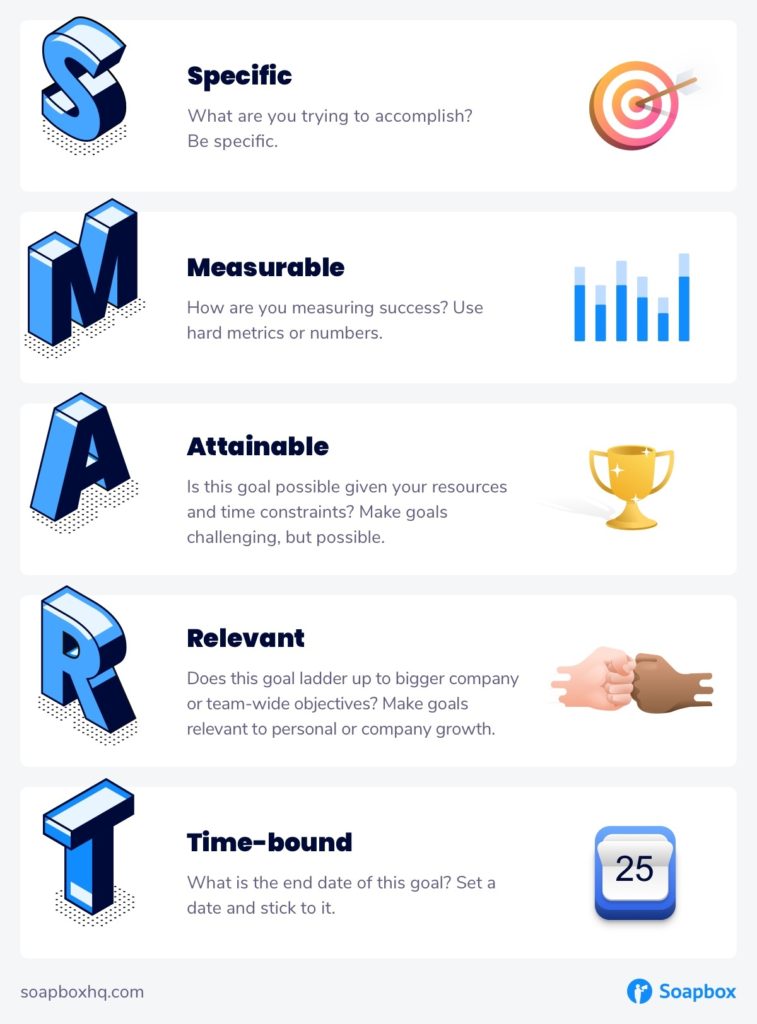
The SMART framework is designed to help create goals that are clear, carefully planned, and easy to track.
Let’s look at the factors that go into making up SMART goals for your marketing team:
1. Make goals specific
Your marketing team needs to understand your goals and objectives. Understanding means knowing what they need to achieve and how they’ll get there.
Therefore, the goals must be clearly outlined and as precise as possible. There is no space for vagueness or language that is open to multiple interpretations here. Be specific.
Here’s an example of a goal that’s not specific:
“Improve content performance by 15% this quarter.”
Just saying “content” isn’t specific enough. Instead, try:
“Improve MQL generation across all blog posts by 15% this quarter.”
2. Make goals measurable
Setting measurable goals means understanding the metrics you will track and how you will determine the success or failure of your campaign. Measuring success or failure is vital as it allows you to monitor your progress, assess what is working well, and make amends accordingly.
Therefore, you must set key performance indicators (KPIs) and benchmarks, and communicate these clearly to your team.
3. Make goals achievable
By all means, set the bar high for your team, but ensure your goals are within the realm of what is realistic and practical. You don’t want goals that are too easy that they’re not challenging enough to motivate the team, but you don’t want them to be so hard that people are discouraged from trying in the first place.
Find a happy medium. Take into account your team’s skills, capacity, and other conflicting priorities. It’s best to seek everyone’s input on whether a goal is achievable before finalizing it.
You must also take into account factors such as the time available, vacation time, and the budget for the project.
4. Make goals relevant
Project and campaign goals within the marketing team must relate to the objectives of your company as a whole. Ensure you effectively communicate the company vision so that your team understands the underlying purpose behind each goal and campaign.
Here’s an example: imagine your company wants to grow revenue by 20% year-over-year. Your marketing team’s objective could be to bring in 20% more qualified leads in order to help towards that overall goal. The marketing goal is directly relevant to the company’s larger mission.
5. Make goals time-bound
Goals must have a deadline. Without it, you risk your team feeling directionless and perhaps even slacking off due to a perceived lack of urgency. Creating a timeline for the campaign will help you determine whether you’re on track to achieving your goals (or not). If things start to fall behind, you can adjust your strategies accordingly.
Your deadlines, like the goal, must be realistic and practical. Ask your team if they can deliver within the desired timeframe. Keep in mind that your timeline should be aligned with the company’s timeline too.
If you want to monitor how long different steps are taking and how much time each team member is spending on the project, you can use a timesheet app to do so.
Now that you understand the anatomy of a SMART goal or objective, let’s look at how to write them.
Writing marketing objectives
Writing marketing objectives requires careful thought, planning, and strategy. Here are the steps you should follow.
1. Set a single sales target that aligns with your marketing goals
Marketing and sales go hand in hand. Your marketing efforts exist to increase sales or conversions. Therefore, when setting your marketing goals, you should ensure that sales and marketing goals are aligned and complement one another.
If you don’t already have a defined monthly sales target for your team, work backwards from your company’s annual sales target. If you’re setting a quarterly revenue goal for your team, this is how you should go about doing it:
Calculate what your marketing team contributed last quarter.
Use those numbers to create new targets for the coming quarter (i.e. 10% increase in marketing attributed revenue quarter-over-quarter).
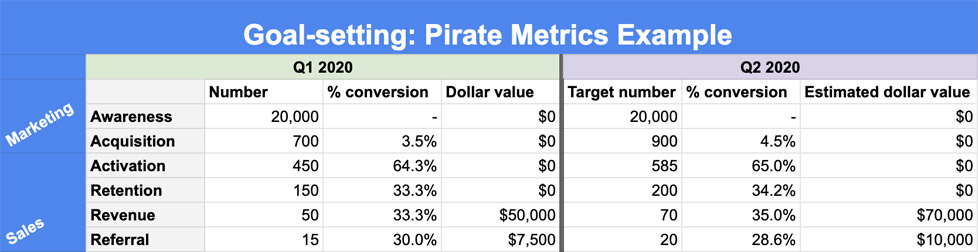
Look at your funnel and conversion rates from the previous time period and use that to determine your goals and objectives. For example, if you’re using pirate metrics, here’s an example of what numbers you’ll need to determine your marketing goals:
Your sales target can be communicated in a total dollar figure or as a percentage increase.
2. Determine your marketing targets by channel
As you create your marketing goals and objectives, determine your targets for each channel. These probably won’t be equal across all channels. Your marketing targets should depend on the behavior of your desired customer base and your customer engagement strategy.
Determine the results you’d like to see not just overall, but from each of your main marketing channels.
3. Break down your goals into monthly and quarterly targets
Seeing huge target numbers can feel overwhelming or impossible to achieve. By breaking down your goals into monthly and quarterly targets, you’ll make them feel much more achievable. In addition, the team gets a buzz and a burst of motivation each time it hits one of its interim goals.
When breaking down your annual goals into smaller ones, keep in mind busier and quieter periods. For example, if you’re a SaaS company, you likely won’t be getting as many signups for your product during December. That’s why it might be worth frontloading earlier months with higher targets to make up for the numbers you’ll likely experience in December.
4. Combine all key goals in one summary paragraph
Combine all your key goals into one short summary. This should be no more than a sentence or two, or a paragraph at most.
A simple example might be: “we will increase sales of our premium product by 10% by the end of the year.”
5. Create a visual marketing plan
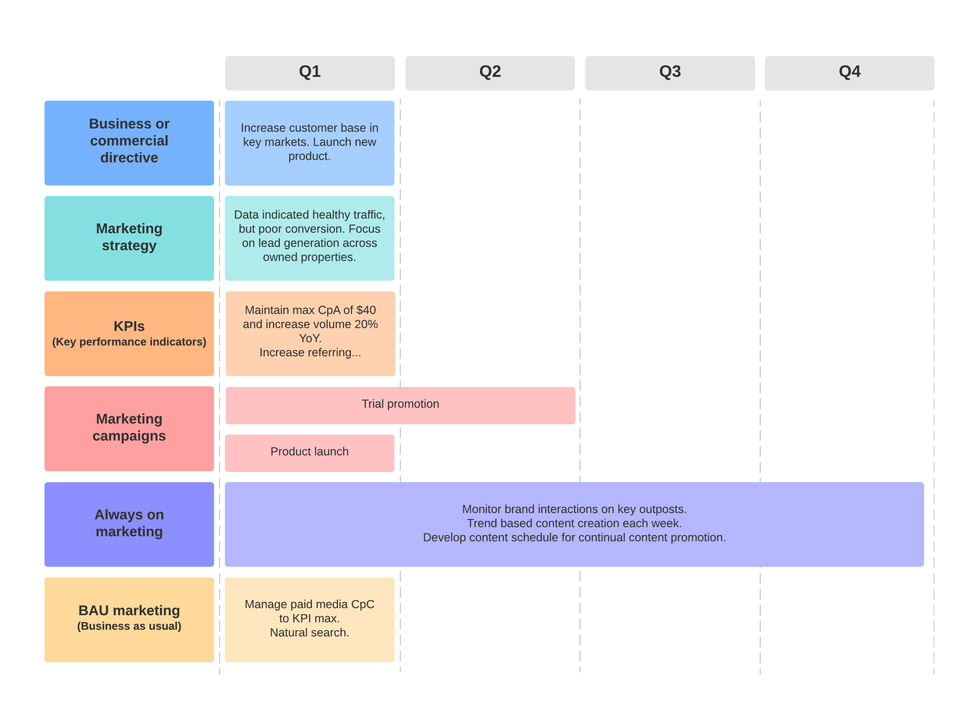
Your visual marketing plan should be a one-page document that outlines your key goals, objectives, and the timeframe for achieving them. Here’s a good example of how it might look:
A visual plan makes it easier to see where you are and where you’re trying to get to at a glance. Distribute it to all members of the team. You can even color-code responsibilities by team members if you wish. You can also add the resources you’re using to reach your goals, such as the social media management tools and communication channels that your team will be working with.
Set clear key performance indicators (KPIs)
Once you have your goals and objectives, it’s time to assign key performance indicators (KPIs). KPIs are there to help you determine whether or not you’re on track to achieving your objectives and goals. Like your goals, they should be as specific as possible.
KPI examples for marketing teams:
Lead generation. This might encompass total number of leads, increase in leads, cost per lead, or leads generated per channel. 300 MQLs from organic traffic this quarter.
Newsletter growth: Email marketing is a channel you own and have full ownership of, so it’s an important channel to keep in your marketing mix. Metrics can include CTR, open rate, unsubscribe rate, total subscribers, etc. 3,000 new signups to our email newsletter this quarter.
Website metrics. This might include new website visitors, page views per visit, time spent on-site, or bounce rate. Decrease bounce rate from 20% to 15% by the end of the year.
Market share. This is the portion of the market that your brand controls. You might wish to increase your market share by a specific percentage in your niche or region. Increase market share by 5% by the end of the quarter.
New customer acquisition. This includes total number of new customers, cost per new customer, percentage increase in new customers, and lead-to-conversion rate. Decrease customer acquisition cost by 15% by the end of the quarter.
Lifetime value of a customer. How much does someone spend with your company on average over the lifetime of their relationship with you? Increase LTV by 15% this year.
SEO performance. This includes metrics like total organic traffic, search engine results page position, and number of keywords your website ranks for. Secure 1-3 position rankings for 90% of our target keywords by the end of the year.
Conversion rates. How many people performed your desired action? In sales, this probably directly correlates with people who made a purchase. Increase conversions from MQL to SQL from 30% to 35% this quarter.
Sales growth. Is your total revenue and total number of customers growing over time? Drive $500,000 in marketing-attributed revenue this quarter.
More goal-setting resources for specific marketing roles
Want more marketing goals? Check out these 180+ OKR and goal examples for every role in tech. Check out role-specific examples for these positions:
Make sure you and your team members agree on your KPIs. This ensures that you will all be guided by the same metrics.
Tracking marketing goals
For the duration of your marketing campaign, you’ll need to monitor whether or not you’re on track to hitting your goals based on your KPIs. Here are some of the best ways to do that:
With Spinach AI Goals, you can collaboratively set role-specific and team goals, measure them and ensure that you’ll discuss them more frequently than at the end of each quarter. With a library of over 180+ goal examples, you and your team will always have a fresh source of inspiration to set ambitious, but attainable goals.
Spinach AI’s software will also ensure that you’re talking about goals during every one-on-one and team meeting (if you choose to do so), that way they’re always top of mind.
Many of the available marketing software tools allow you to track progress towards your objectives. You can:
Customize your dashboard to include the relevant KPIs
Automate many processes and receive automatically generated reports based on parameters you specify
Share these reports with the relevant members of your team and other stakeholders.
Excel spreadsheet
The downside to Excel is that you have to input everything manually. That makes it a time-consuming choice for tracking your KPIs and progress towards your goals. However, it’s an affordable option and many companies still use it. If you’re knowledgeable about Excel and managing a relatively simple project, it can work effectively. On the other hand, you can also consider a more collaborative option like Google Sheets.
Encountering a problem
If you’re leading a marketing team, you’ll need to be on the lookout for potential problems so you can head them off early before they impede progress towards your team goals. By keeping track of your marketing goals and monitoring progress towards KPIs on a regular basis, you’ll be able to identify and tackle roadblocks as they come up. Then you can support your team or adjust the campaign accordingly.
Make sure you keep all relevant stakeholders updated. Problems happen, but trying to ignore them or brush them under the carpet is a mistake. Communication with your team and others within the company is the best way to spot problems early and resolve them before they become critical.
Wrapping up
Goal-setting is key to the success of any marketing strategy. And following the SMART—Specific, Measurable, Achievable, Realistic, Time-bound—system will help you to create appropriate goals and achieve them.
Get your whole team involved with goal-setting. If everyone has a voice in the process, they’ll be more invested and more likely to achieve those goals. Ensure that there is clear and open communication throughout the project so that you can monitor success and head off any small problems before they become big ones.
With a collaborative approach and a great set of SMART goals, your team will be well on their way to smashing all its targets.
Owen Jones is the Senior Content Marketer atZoomshift, an online schedule maker app. He is an experienced SaaS marketer, specializing in content marketing, CRO, and FB advertising.
Push your team towards success with Spinach AI Goals
 Owen Jones